
Layers and the dependency rule
Status: current. This page describes the layers as they stand after the last phase of the refactor plan.
Why layers
A function that can reach vscode can only be tested inside the extension host. A rule about notes that sits in a view can only be reused by importing the view. At v1.23.1 both happened: 101 of the 171 non-test source files imported vscode, and src/core imported from src/ui. Now 134 of 467 do, all of them in ui, platform, composition, and extension.ts, and core imports neither. The layers below put each kind of code where its dependencies are the fewest it needs.
The layers
src/
  domain/          Pure model and rules. No vscode, no I/O, no ui.
    model/         notes, tasks, tags, links, index
    markdown/      parser, taskFields, taskLineEdits, recurrence, dates, lineShapes
    query/         parser, evaluator, dates, format, edit
    index/         IndexState, associations, backlinks
    ranking/       related notes, similarity, frecency, recency, tag hygiene, entry labels
    tasks/         agenda placement, board moves, reschedule, columns
    graph/         notes graph construction, local graphs, change detection
    search/        search facets, unlinked mentions
  core/            The index (workspace/) and the stores (storage/): vscode-free.
  shared/          Small helpers every layer may use: text, paths, html, timing.
  services/        Application logic: one class per capability, vscode-free.
  ports/           Interfaces the services need.
  platform/        vscode implementations of the ports.
  ui/
    commands/<feature>/  Thin handlers; each feature exports register(context, services).
    providers/     Completion, CodeLens, hover, decoration, diagnostic providers.
    views/         Tree views and status bars, display only.
    state/         View models built from the index, vscode-free.
    preview/       The Markdown preview's query blocks and embeds.
    webview/
      host/        WebviewHost, PageController, sharedHandlers, the page shell and chrome.
      pages/<page>/ Host controller and snapshot builder for each page.
    protocol/      Message and snapshot types shared by host and page.
  webview/         Browser code, bundled by esbuild.
    shared/        The Preact core, the parts pages share, the calendars', and the sheets.
    <page>/        main.tsx, the page's own components, and page.css
  composition/     createServices, the features list, and runFeatures: the
                   composition root's other half.
  extension.ts     Composition root only.
| Layer | Holds | May import |
|---|---|---|
domain |
Pure types and rules: parsing, querying, ranking, task placement, graph building | domain and shared |
core |
The index (IndexService, the scanner, the watcher, the publisher) and the stores (preferences, the search store and its worker) |
domain, ports, and shared; never ui or vscode (core-not-to-ui, core-not-to-vscode) |
services |
One class per capability, such as TagService or TaskService |
domain, ports, core, and shared |
ports |
Interfaces: FileSystem, Configuration, KeyValueStore, Clock, EditApplier, Log, Progress, WorkspaceFiles, WorkspaceEvents, and the Event and ResourceUri shapes they use |
domain types and other ports only |
platform |
The VS Code implementations of the ports | ports, domain, and vscode, never what uses it |
ui |
Adapters: command handlers, providers, tree views, webview hosts, view models, and the protocol | services, core, domain, shared, and vscode. ui/protocol may import only domain/model, and ui/state never vscode or a command, view, or page host |
webview |
Page code that runs in the sandbox | Its own folder, webview/shared, ui/protocol, the domain modules D1 names, and Preact |
extension.ts, composition |
The composition root: createServices builds the ports and services, each feature registers against them, and startServices starts the index |
Every layer. extension.ts and composition/services.ts are the only modules that may import platform |
D1: the domain modules a page may import
A page computes some things for itself, from rules the host also applies or that only the page needs at the speed of a keystroke. Those rules stay in domain, and a page imports them by name: decision D1 of the webviews plan. The list is PAGE_DOMAIN_MODULES in .dependency-cruiser.cjs, which pages-import-protocol-and-shared reads, and the same files are in src/webview/tsconfig.json, so each is type-checked against the browser’s types before a page imports it. As Phase 6 left it:
| Module | What a page computes with it | Imported by |
|---|---|---|
domain/graph/communities.ts |
The graph’s groups and the links it draws: buildCommunities, choosePrimaryTags, and selectSalientEdges |
The Notes Graph (view.ts, model.ts) |
domain/markdown/calendar.ts |
The date steps both calendars take: stepDate, sameShownDayIn, isWeekend, chooseFocusDay, and stepCalendar |
The calendars’ shared parts (shared/calendar/) and the calendar page |
domain/markdown/tagKeys.ts |
A namespace’s words for its filter: formatKeyWords. The namespace itself comes from the host, read by the parser’s getEntityNamespace (which reads a key through readTagNamespace, here too) |
The Dashboard’s Tags tab |
domain/tasks/taskColumns.ts |
Whether a status column or a board namespace the reader typed can be taken: checkNewStatusColumn and checkStatusNamespace |
The Task Board’s settings |
domain/tasks/progressCount.ts |
How far along tasks are, shown and spoken: formatProgressCount, speakProgressText, progressPercent |
Every progress figure and bar |
domain/tasks/statusChecks.ts |
What a list of task statuses gets wrong, as it is typed: checkStatusList |
Edit Task Statuses |
domain/tasks/boardLanes.ts |
Which axes Lanes offers beside a Group, and why a cell of a board with lanes will not take a card: listLaneAxes, isLaneAxisFor, and refuseCellMove |
The Task Board |
domain/dashboard/widgetCatalog.ts |
Which Home widgets there are, and what each can do: WIDGET_KINDS and isWidgetKind; and the limits the host keeps, so the page offers no more: HOME_WIDGET_LIMIT, WIDGET_ENTRY_COUNTS, QUICK_ADD_MAX_LENGTH, and isWatchableNamespace |
The Dashboard |
Each imports nothing but types from domain/model, and domain-is-pure keeps it free of vscode and I/O, so what a page bundles from it is the rule and nothing more. A module joins the list in the change whose page first needs it, in both places.
ui/commands/<feature> exists now. Twenty feature modules, from setup to hubs, each export register(context, services), which registers its commands through registerCommand and takes what they use from the Services object createServices builds; services.md lists them. A feature imports the Services type from composition/services.ts, type-only, and reaches the page hosts through it, since a command may not import a page host’s module. The commands whose handlers were not already in ui/commands moved into their feature’s module.
ui/providers exists now. Each completion, CodeLens, hover, decoration, and diagnostic provider takes only its collaborators in its constructor and subscribes to VS Code in register(), which returns the provider, so createServices builds and registers each in one expression at the point in activation where it always registered. What a provider draws with, its decoration types or its diagnostic collection, is still made with it, so a test can call its draw and check methods without registering anything. The rules the providers apply are in domain, where test:unit runs their tests: markdown/completionContext, markdown/taggedEntries, markdown/repeatRuleProblems, and index/wikiLinkTargets. ui/providers/codeLenses holds the lazy lens and the locate lookup the two lens providers share. No provider is reached through its old path under ui/commands; Phase 7 deleted those re-exports with the rest.
The rule
flowchart LR
  extension["extension.ts"] --> ui["ui"]
  ui --> services["services"]
  services --> domain["domain"]
  services --> ports["ports"]
  ports --> domain
  platform["platform"] --> ports
  extension --> platform
  page["webview"] --> protocol["ui/protocol"]
  page --> shared["webview/shared"]
Every arrow points from the importer to what it imports. Nothing points back up. Only the composition root, extension.ts and composition/services.ts, imports platform, because it builds the implementations and hands them to everything else. services never sees vscode; it sees a port, and platform supplies the VS Code version of it. That is why a service can be tested under plain mocha with a fake port. webview is separate from the host entirely: it runs in the sandbox and shares only the protocol types with the host, so a page cannot import host code by accident.
What goes where
Ask these questions in order, and stop at the first yes.
- Does it run in the page? It belongs in
src/webview. - Is it a rule about notes, tasks, or tags with no I/O and no clock read? It belongs in
domain. - Does it carry out a user action, reading and writing through ports? It belongs in a service.
- Does it call a VS Code API to satisfy a port? It belongs in
platform. - Does it ask the reader something or show them something? It belongs in
ui.
Some examples from the audit:
| Today | Target | Why |
|---|---|---|
rankRelatedNotes in ui/state/relatedNotesRanking.ts |
domain/ranking/relatedNotes.ts (done in Phase 4) |
It is a pure ranking engine wearing a view-model name. createSidebarSnapshot, which shapes its result for the sidebar, stays in ui/state. |
createNotesGraphSnapshot in ui/state/notesGraphState.ts |
domain/graph/notesGraph.ts (done in Phase 4) |
It builds a graph from the index. toWire, which trims it for the page, stays in ui/state. |
buildWorkspaceIndex in core/workspace/indexer.ts |
domain/index/indexState.ts (done in Phase 1) |
It is pure, and 54 test files imported it through a module that imported vscode. |
listOverdueTasks in ui/views/agendaTree.ts |
AgendaService.listOverdue, over selectOverdueTasks in ui/state/agendaState.ts (done in Phase 4; the status bar still takes listOverdueTasks from ui/commands/agendaActions.ts, which reads the settings itself) |
The status bar and extension.ts imported a domain query from a tree view. |
panelPriority and viewPriority in core/workspace/publishing.ts |
ui/webview/host/panelPriority.ts (done in Phase 6 step 2.1) |
They map a panel’s visibility to a redraw priority, which is a UI concern. |
core/types.ts |
domain/model and ui/protocol (done in Phase 1; the file, a re-export shim since then, is deleted in Phase 7, and every importer names the module that declares what it imports) |
45% of it was webview view models and 34% webview messages. |
How the rule is enforced
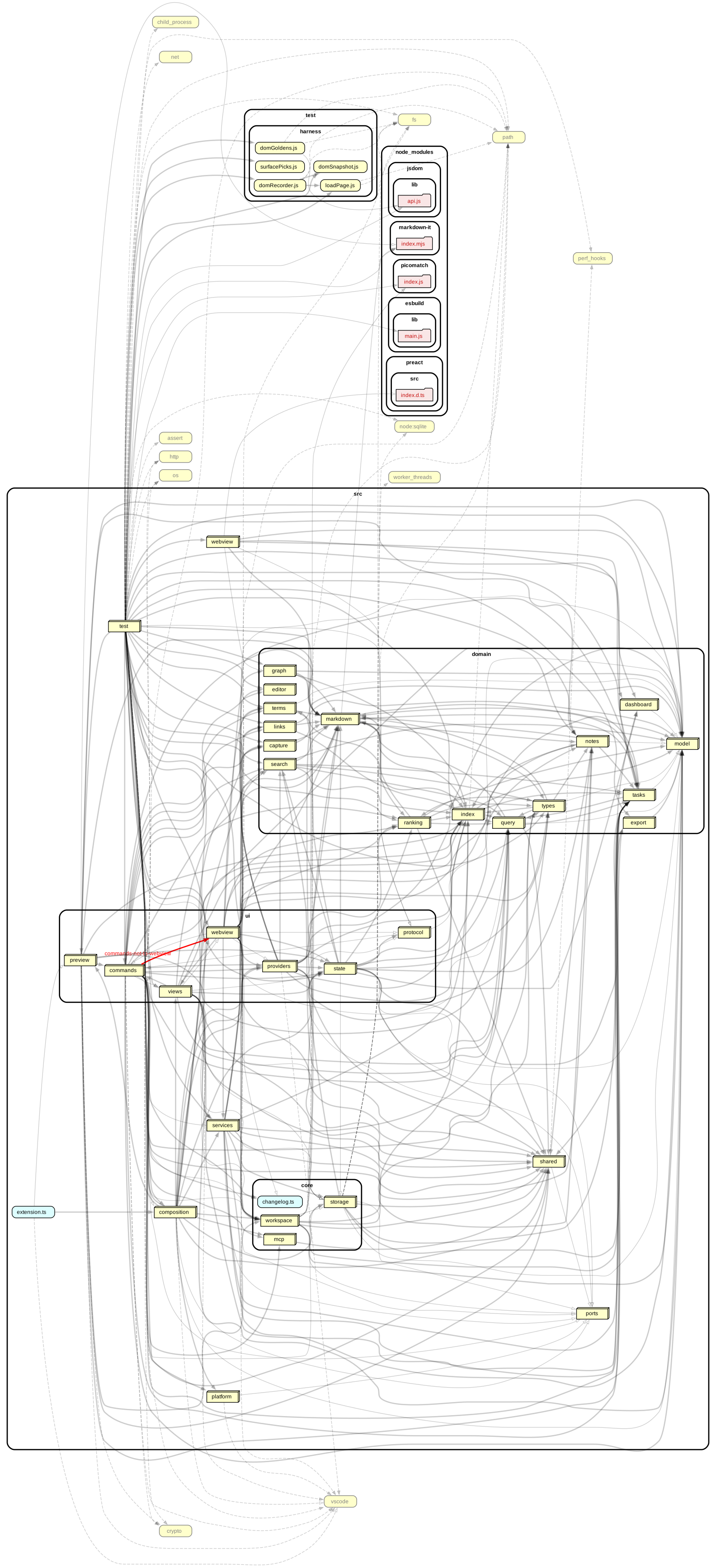
dependency-cruiser runs in npm run lint from Phase 0, so a wrong-way import fails CI rather than waiting for a review. Its rules live in .dependency-cruiser.cjs. Every rule is at severity: error, because the exit code counts only errors.
| Rule | What it stops |
|---|---|
domain-is-pure |
domain importing vscode, a Node I/O module, or any layer above it |
services-use-ports |
A service importing vscode, a Node I/O module, platform, or ui, so it reaches all of them only through ports |
ports-are-interfaces |
A port importing anything but domain and other ports |
platform-implements-ports |
platform importing what uses it |
only-the-composition-root-imports-platform |
Any module but extension.ts and composition/services.ts importing platform |
protocol-is-shared-types |
ui/protocol importing anything but domain/model |
pages-import-protocol-and-shared, pages-not-to-other-pages |
Page code importing host code, or another page’s folder. Besides its own folder, webview/shared, and ui/protocol, a page may import the five pure domain modules D1 names (above). |
pages-ship-only-preact |
Page code importing any package but Preact, since whatever a page imports is bundled into it and ships |
host-not-to-page-code |
Host code importing page code, which it reaches only by URI |
search-worker-never-reaches-vscode |
The worker’s closure reaching vscode, which fails only at runtime |
no-circular, no-unresolvable, shipped-code-uses-no-dev-dependency |
Cycles, imports that resolve to nothing, and shipped code importing a dev dependency |
A second set holds the older folders to the directions the plan calls wrong: core-not-to-ui, core-not-to-vscode, state-not-to-vscode, state-not-to-commands-views-or-webview, commands-not-to-webview, query-parser-not-to-evaluator, and query-format-not-to-parser. Type-only imports count, because a type imported the wrong way is a dependency a later value import would follow.
The violations the code had when the rules arrived are recorded in .dependency-cruiser-known-violations.json, and --ignore-known lets them through. Any new violation fails, whether a new file in a target layer or a new wrong-way import in an old one. Each phase that removed a known violation regenerated the file with npm run lint:deps:baseline, so the list only shrank. Two remain, both commands-not-to-webview: ui/commands/chooseTheme.ts imports ui/webview/themes.ts and ui/webview/themeNames.ts. The second is the theme names it once took through themes.ts, recorded again when Phase 7 deleted that re-export. The first run is the baseline in inventories/import-graph.md.
The same rules also choose which test suites can run under plain mocha: a suite qualifies when none of its modules reaches vscode. See testing.md.